Turn 500 Pages Into a Cheatsheet That Could Make Your Professor Proud
Turn hundreds of pages of course materials into a focused, exam-ready cheatsheet that helps you review what actually matters.
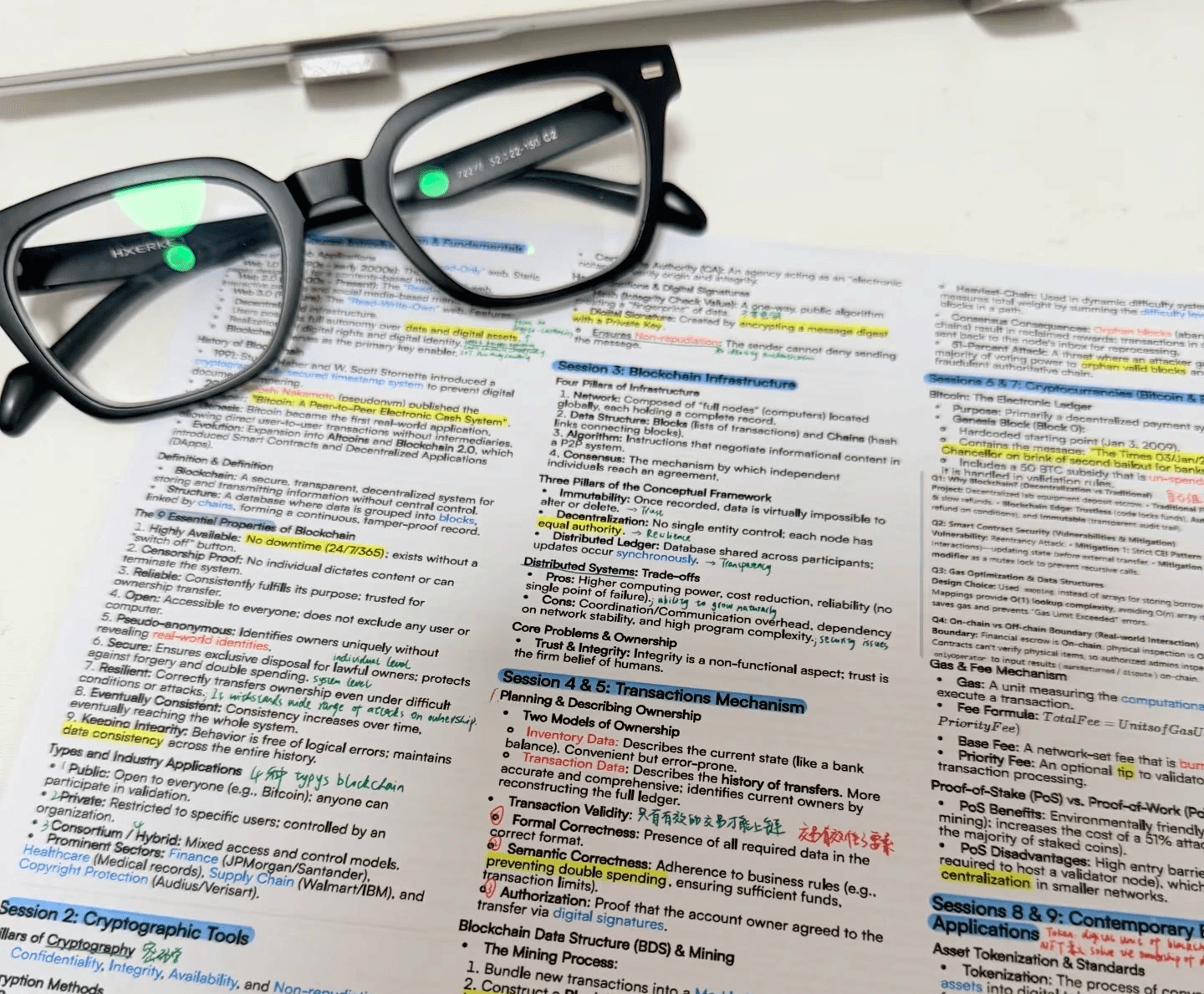
The paradox of making a cheatsheet is trying to distill 500 pages of material into 1 page of concentrated review that is both as concise and detailed as possible. Worse, you need to know the material without the cheatsheet in order to effectively create one. You need to know which concepts carry the most weight, which formulas appear repeatedly, which definitions the exam will test and which ones are background noise. You need, in other words, the exact judgment that studying is supposed to build.
Students who already have that judgment do not need a cheatsheet. Students who actually need one cannot build a good one. The act of creating a study guide is pedagogically valuable, but only if the selections are right, and to be frank, most students get the selections wrong in predictable ways.
Sometimes students include too much, transcribing half the textbook into slightly smaller font and which ends up in a document so dense it could be used as stealth panels on a jet.
Other times include too little. They pick the concepts they remember easily, which are by definition the ones they least need to review, and skip the material that has not stuck, and suddenly realize their cheatsheet is just as clueless as they are come exam day.
This is where AI makes the greatest difference in your studying. An AI trained to read all 500 pages does not suffer from the same recall biases that plague human note-takers. The agent can process every page with equal attention, identifying concepts by frequency of mention, structural emphasis, and relationship density rather than by how memorable they happened to be during a Tuesday afternoon lecture.
How to Use Hyperknow Cheat-Sheet Generation Function
The workflow is deliberately simple because the students who need this most are usually operating under significant time pressure.
You first upload your materials. This can be a textbook chapter, a full textbook, lecture slides, your own notes, or any combination. Agents like Hyperknow parse through your esoterically worded textbook from 10 years ago be it Pathology textbooks, organic chemistry references, and constitutional law casebooks.
Select cheatsheet generation. The system does not simply extract highlighted text or pull topic sentences. It builds a representation of the entire document's conceptual structure and then compresses that structure into a format optimized for rapid review. Key definitions surfaced. Formulas collected and contextualized. Relationships between concepts mapped rather than merely listed.
Why Machine Compression Beats Human Compression
The difference between a human-built study guide and an AI-built is coverage. When you sit down to make a study guide, your brain does something sneaky, by gravitating toward material you already understand because engaging with familiar content feels productive. Chapter 7 made sense during lecture, so you write thorough notes on Chapter 7. Chapter 12 was confusing, so you write vague notes that mostly say "review this more" and move on. As a result, your study guide now has excellent coverage of your strongest areas and terrible coverage of your weakest. Consequently, you successfully studied the answer you would have gotten right by being more right while ignoring the areas you actually need to work on.
AI processes Chapter 7 and Chapter 12 with identical attention. It does not get confused by Chapter 12 and retreat to something easier. It does not experience the psychological discomfort of engaging with material it does not understand. The output reflects the actual distribution of important concepts across the entire source, not the distribution of concepts you happened to remember.
This is not a small effect. The difference between a study guide that covers your weak areas and one that avoids them is, in many cases, the difference between understanding 60% of the exam and understanding 85%.
What the Output Looks Like
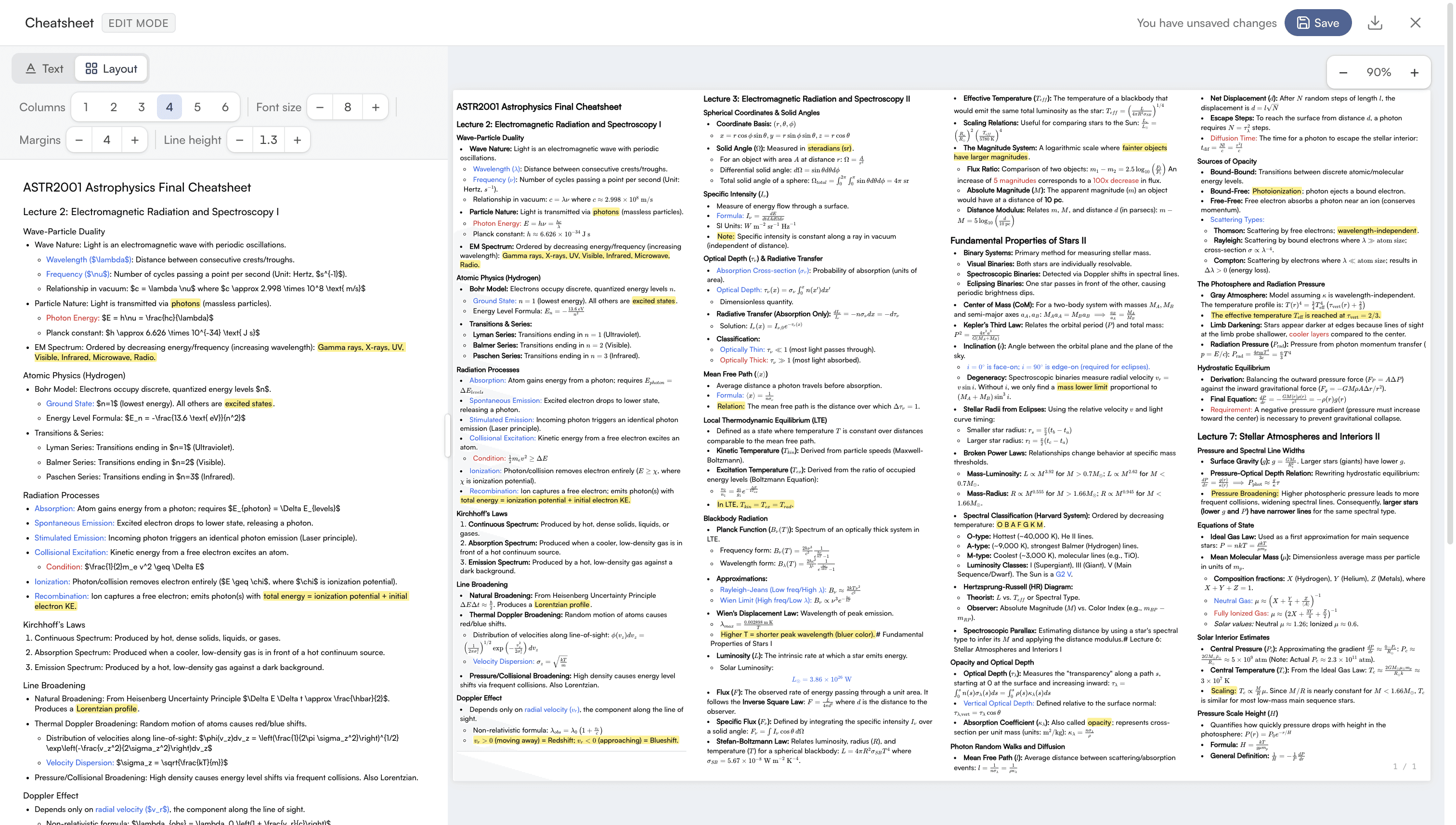
Expectations matter, so here is what you are getting and what you are not.
You are getting a structured document organized by topic rather than by chapter. This distinction matters because textbooks organize information linearly but exams test it thematically. A biology cheatsheet organized by "cell division, DNA replication, protein synthesis" is more useful during an exam than one organized by "Chapter 4, Chapter 5, Chapter 6" because the exam will not tell you which chapter a question came from.
Key terms appear with definitions that reflect how the source material defined them, not generic dictionary definitions. If your textbook describes homeostasis differently than Wikipedia does, the cheatsheet uses your textbook's framing. This seems like a minor detail until you lose points on an exam for using terminology your professor never taught.
Formulas and equations are collected in context. Not just the formula itself but when to use it, what each variable represents, and which problems in the source material it appeared in. A formula without context is just symbols. A formula with context is a tool you can actually deploy under pressure.
Relationships between concepts are surfaced explicitly. If the source material discusses how the sympathetic and parasympathetic nervous systems interact, that relationship appears in the cheatsheet even if the two systems were covered in different chapters. These cross-chapter connections are exactly the kind of thing exams test and exactly the kind of thing students miss when they study chapter by chapter.
You are not getting a replacement for studying. A cheatsheet is a compression tool, not a comprehension tool. Reading through a perfectly generated cheatsheet without engaging with the underlying material will produce the same illusion of understanding as reading the original textbook without engaging with it. The value is in focusing your attention on the right material, not in skipping the cognitive work of actually learning it.
Timing
The obvious use case is finals week. Your exam is in 36 hours and you need to consolidate four months of material into something reviewable. Upload everything. Generate the cheatsheet. Use it to identify your gaps. Study the gaps.
But the less obvious use case might be more valuable.
Generate a cheatsheet after each unit throughout the semester. Not as a last-minute cram tool but as a regular consolidation practice. Every three to four weeks, upload the accumulated material from that unit and generate a compressed review. Read through it. Test yourself on the concepts it highlights. Identify anything that does not make sense and address it while you still have time, office hours, and a professor who is not yet drowning in end-of-semester grading.
Students who do this arrive at finals week with twelve weeks of pre-built cheatsheets that they have already reviewed at least once. Their final prep becomes a review of reviews rather than a first-pass scramble through raw materials. The time investment is maybe thirty minutes per unit throughout the semester. The payoff during finals is enormous.
The Professor Question
Some professors allow cheatsheets during exams. One page, both sides, handwritten or typed. If yours does, the AI-generated output is a starting point, not a final product. Use it to identify what belongs on your allowed cheatsheet. Then rebuild it in your own format, at your own density, with your own organizational logic. The act of rebuilding forces a cognitive pass through the material that passive reading does not.
Some professors explicitly forbid outside materials during exams. The cheatsheet is still valuable, not as something you bring into the exam room but as something you study from the days before. A well-built cheatsheet is the most efficient review document available because it contains only what matters and excludes everything that does not.
Either way, the document exists for your brain, not for the exam table. What sticks in your memory from reviewing it is what you carry into that room.
The Honest Limitation
AI cheatsheet generation is excellent at compression and terrible at judgment calls that require human context.
It does not know that your professor always asks one question about a specific historical anecdote she mentioned in lecture but never included in the slides. It does not know that your TA emphasized a particular type of practice problem during the review session. It does not know that last year's exam heavily weighted the final three chapters.
These are the kinds of intelligence that come from paying attention to the humans in your course, not from processing the documents. The best study strategy combines AI compression for the material itself with your own contextual knowledge about what the specific exam will emphasize.
Upload the materials. Let the AI handle the 500 pages. But bring your own judgment about what your professor cares about. The cheatsheet gives you what. You provide the weighting.
Upload your course materials and get an exam-ready cheatsheet in minutes. Try Hyperknow free.