How to Study with AI and let it study for you
Learn how to use AI as a real study partner: grounded in your course materials, focused on active recall, and built to help you understand instead of shortcut.
There are roughly 800 million weekly ChatGPT users right now, a meaningful percentage of them are college students, and—let’s be honest—that same meaningful percentage are currently using AI in a way that is degrading their future exam performance.
The pattern looks something like this: Student receives assignment. Student pastes the prompt into ChatGPT. Student skims the output. Student then submits or, more charitably, “builds on” the output as a "starting point" that they lightly rephrase. Student moves on feeling productive as they go back to doomscrolling.
Come exam day where the student only has themselves to rely on, they discover that they remember nothing because reading someone else's answer and understanding a concept are two entirely different cognitive activities. One pretends to be learning (or as the children say—larps) while the other actually is just learning, and unfortunately our brains don’t care for which one feels better.
This problem is the central tension of AI in education right now as the same technology that can accelerate learning can also become your biggest crutch and using this technology the smart way requires its own discipline.
Your Materials First, the Internet Never
The first mistake students make with AI study tools is asking generic questions about a topic instead of feeding the AI their actual course materials.
Think of it like ordering at McDonalds. You can say “a burger” and the cashier will say “what kind of burger” and “make up your damn mind or wait at the back.” Alternatively, if you want to avoid embarrassment, you can say “number 7 with extra fries and an extra large smoothie” and specify what you want. Besides reminding you to eat, this example is a key demonstration to why specificity matters.
Your upcoming organic chemistry exam will not test you on "organic chemistry" as a general concept. It will test you on the specific reactions your professor covered, the specific mechanisms demonstrated in your lecture slides, the specific nomenclature conventions your textbook uses. A ChatGPT explanation of SN1 vs SN2 reactions might be excellent. It might also emphasize details your course never touched and skip the exact framing your professor spent twenty minutes drilling into.
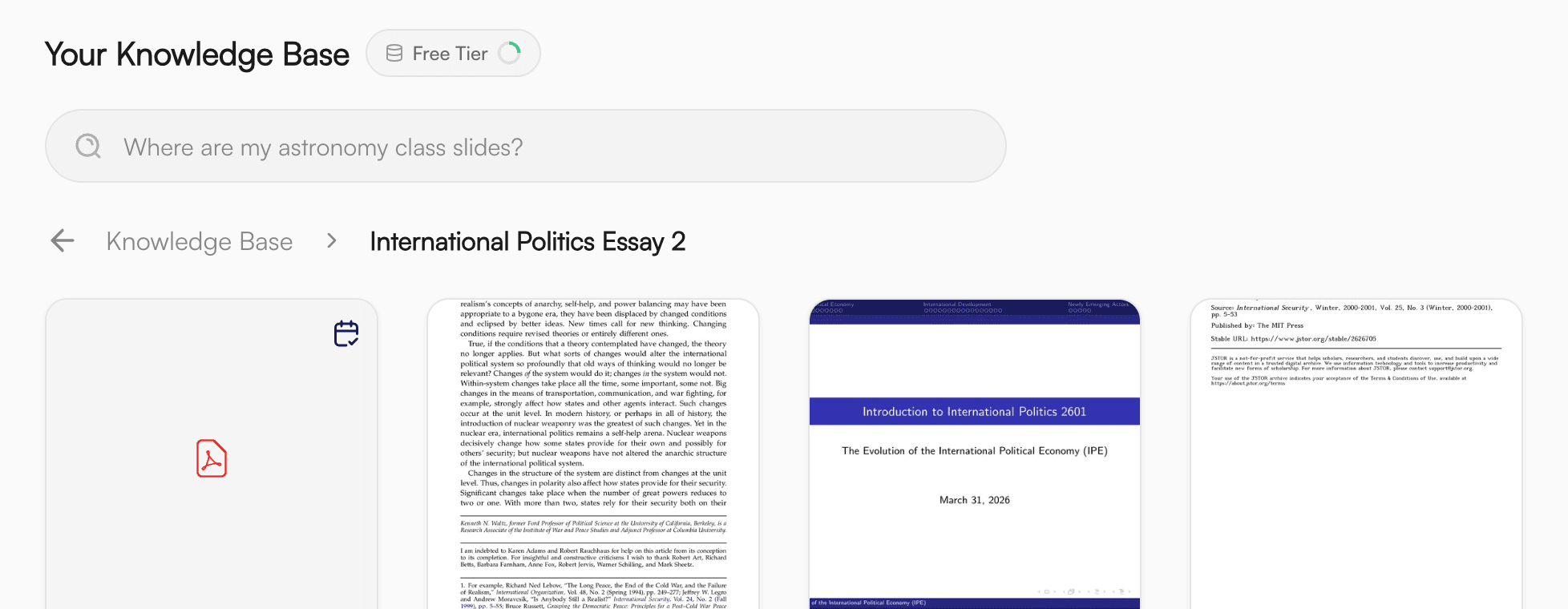
The fix is just doing a little more prepwork. Upload your materials like lecture slides, textbook chapters and your own notes first. Let the AI ground itself in what you actually need to know, not what stack-exchange from 2012 thinks you should know. The difference between studying with an AI that has read your syllabus and studying with one that has not is the difference between a tutor who attended your class and a stranger at a coffee shop who happens to know chemistry.
Some tools handle this better than others. Hyperknow reads up to 1,000 pages of uploaded material and generates every output from that specific content. NotebookLM does something similar with Google's infrastructure. StudyFetch processes your uploads through its Spark.E tutor. The common thread is that all of them become dramatically more useful the moment you stop asking general questions and start feeding them your actual coursework.
Testing Yourself Is the Entire Point
Here is where most students get the AI study workflow exactly backward.
The natural instinct is to use AI for consumption. Summarize this chapter. Explain this concept. Give me the key takeaways. The student reads the summary, nods along, and moves to the next chapter feeling like progress happened.
Surprise surprise, it does not.
Decades of cognitive science research, from Roediger and Karpicke's retrieval practice studies to Bjork's work on desirable difficulties, point to the same conclusion. The act of pulling information out of your memory strengthens that memory far more than the act of putting information in. Reading a summary is putting information in. Attempting to answer a question from memory is pulling information out. Only one of these will save you during an exam.
The most effective AI study workflow flips the default. Instead of asking the AI to explain things to you, ask it to quiz you on things you should already know. Upload your lecture slides from last week. Have the AI generate twenty practice questions, close the source material, then attempt every question before looking at the answers.
The discomfort you feel when you cannot recall an answer is not a sign of failure. You have to remember that in the days before AI existed, this pain was something we called learning. Your brain flags that gap and prioritizes filling it during the next encounter. If you skip the discomfort by reading the answer immediately the gap in your learning persists, invisible and dangerous, until exam day.
Moreover, knowing the materials will help ensure you can spot any hallucinations. LLM memory might be inconsistent across context windows, sometimes your prompt isn’t specific enough or the AI straight up makes stuff up. Being the human expert in the loop is the last line of defence between you and a below the median exam score.
This approach works with any AI tool, ChatGPT can generate generic practice questions if prompted correctly, while specialized tools like Hyperknow builds entire Deep Learn Sessions around this principle, structuring interactive tutoring that adapts based on what you get wrong. Quizlet's flashcards achieve a similar effect through simpler means. The specific tool matters less than the fundamental behavioral shift from passive consumption to active retrieval.
Let AI Find What You Missed
Every student has blind spots in their notes. It’s normal to zone out for four minutes during a lecture and miss the transition between topics. You highlight a paragraph in the textbook but do not actually process what it says. You write a summary that accidentally omits an entire section because you confused two similar-sounding concepts.
These gaps are invisible to you, and that’s what most of us are terrified of—seeing a giant page on your test that you have absolutely no idea about.
Luckily for you, AI is exceptionally good at this specific problem.
Upload your notes from a lecture alongside the original lecture slides. Ask the AI to identify topics that the slides covered but your notes did not. The output is a map of your blind spots that include sections where your attention wandered, concepts you thought you understood but described incorrectly and even entire topics you somehow skipped.
This process is diagnostic studying. You are not asking the AI to teach you everything, just asking it to tell you where you need to focus. This is the distinction that makes or breaks GPAs when time is limited. A student with ten hours before an exam who spends all ten hours reviewing material they already know is wasting most of that time. A student who spends the first thirty minutes identifying their actual gaps and the remaining nine and a half hours addressing them will outperform the first student every time.
Hyperknow's approach to this involves cross-referencing multiple uploaded documents against each other. Your notes versus the textbook versus the lecture slides. The gaps surface where the sources disagree about what you should know. Other tools offer similar functionality through different interfaces, but the principle remains the same regardless of platform.
Planning That Survives Contact with Reality
Students build ambitious study schedules on Sunday night. By Tuesday afternoon those schedules are fiction.
This happens because human beings are spectacularly bad at two specific cognitive tasks. Estimating how long things will take and predicting how they will feel about doing those things in the future. You schedule three hours of biochemistry review on Tuesday evening. Tuesday evening arrives and you are exhausted from a lab that ran long. The biochemistry gets pushed to Wednesday. Wednesday has its own problems. By Thursday the schedule is meaningless and you are back to studying whatever feels most urgent at the moment.
AI-assisted study planning helps with the first problem. A system that has read your syllabus knows exactly how many topics each exam covers and can distribute review time proportionally. It can weight difficult subjects more heavily. It can account for spaced repetition intervals so you review material at the optimal time for retention rather than whenever you remember to.
The second problem, the motivational one, is harder. No AI can make you want to study biochemistry on a Tuesday night. But proactive systems can reduce the decision fatigue that makes procrastination so tempting. When you open your study tool and it says "here is what you should work on right now, and here is why" instead of presenting a blank canvas of possibilities, the activation energy drops. You are not choosing what to study. You are just starting.
Hyperknow builds this kind of calendar from your course materials and LMS imports. It extracts deadlines, estimates workload, and creates a schedule that adjusts when things shift. If you skip a session, the system redistributes rather than leaving a permanent hole in your plan. The goal is not a perfect schedule. The goal is a schedule that degrades gracefully when life gets in the way.
Disclaimer
There is a conversation happening on every college campus right now about where AI assistance becomes academic dishonesty. The line is blurrier than anyone wants to admit, but here is a framework that holds up.
Using AI to understand a concept is studying. You upload a textbook chapter, ask the AI to explain a difficult section in simpler terms, and then work through practice problems yourself. You have used the technology to learn. The knowledge is in your head. The exam will confirm this.
Using AI to produce an answer you submit as your own is not studying. You paste an essay prompt into ChatGPT, clean up the output, and hand it in. The knowledge is not in your head. The exam will confirm this too, with lots of pain, crying and crashing out.
The distinction is not about the tool but what happened in your brain during the interaction. Did you struggle with the material? Did you attempt answers before seeing solutions? Did you come away understanding something you did not understand before? If yes, you studied. If the AI did the cognitive work and you watched, you did not.
This matters in 2026 more than it did in 2024 because detection has improved dramatically. Professors are designing assessments that specifically test for understanding that cannot be faked. Oral exams are returning. In-class writing is replacing take-home essays. The students who used AI to genuinely learn will thrive in this environment. The students who used it as a shortcut will find themselves increasingly exposed.
Where This Is Going
The AI study tools available today are, by any reasonable assessment, primitive compared to what will exist in two years. Current tools can read your materials and generate study content. Future tools will understand how you learn, identify your specific misconceptions, and adapt their teaching style in real time.
Hyperknow is already moving in this direction with its Learner's Persona feature, which builds a profile of your study patterns and adapts content accordingly. Other tools will follow. The competitive advantage of early adoption is not just the time saved today. It is the learning data that accumulates over months and semesters, making the tool increasingly personalized and effective.
But none of this matters if the fundamental behavior is wrong. An AI that perfectly adapts to your learning style is useless if you only use it for passive consumption. The technology amplifies whatever you bring to it. Bring curiosity and active engagement, and it accelerates understanding. Bring laziness and a desire for shortcuts, and it accelerates the illusion of understanding.
The choice is not whether to use AI for studying. That debate ended sometime in 2024. The choice is whether to use it in a way that makes you smarter or in a way that makes you feel smarter. Only one of those will matter when the exam hits your desk.
Ready to see what AI-assisted studying actually looks like? Try Hyperknow with your next exam's materials.