Type a Topic. Get a Video That Explains It in Two Minutes.
Turn any confusing topic, article, or course concept into a focused two-minute video that helps it finally click.
Some concepts refuse to cooperate with text.
You read the textbook explanation of electromagnetic induction three times. Each time, the words are individually clear and collectively meaningless. You re-read your lecture notes. The diagram your professor drew on the whiteboard was apparently important but your sketch of it looks like a weather system.
Then someone sends you a four-minute YouTube video where a magnetic field moves through a coil and electrons begin to flow and you can see it happening. The concept clicks in about ninety seconds. Not because the video contained different information than the textbook. Because your brain processed the same information through a different channel and that channel happened to work.
This is not a matter of learning style preference. Dual coding theory, developed by Allan Paivio and supported by decades of subsequent research, demonstrates that information processed through both visual and verbal channels simultaneously creates stronger and more accessible memory traces than either channel alone. A student who reads about mitosis and watches mitosis happen retains more than a student who only reads, regardless of which modality that student "prefers."
The problem has never been whether video helps. The problem has been finding the right video.
The YouTube Problem
YouTube has over 800 million educational videos. Roughly twelve of them are exactly what you need for your specific course.
That number is made up. But the experience is real. You search for "Krebs cycle explained" and get 47,000 results. Some are 45-minute deep dives that cover ten times more detail than your exam requires. Some are three-minute overviews that skip the exact steps your professor emphasized. Some are from 2014 and use terminology your current textbook has since updated. Some are genuinely excellent but you cannot determine this without watching each one.
The search costs time. Sometimes more time than just re-reading the textbook would have cost. And at the end, the video you find was made for someone else's course at someone else's university with someone else's emphasis on what matters.
Custom video generation eliminates the search entirely. You define the topic. The system produces a video covering exactly that topic, at the depth you need, in about two minutes.
What the Generation Looks Like
The workflow is aggressively simple because the students who need this most are usually in the middle of studying something else and do not want a production process.
Enter a topic. "Krebs cycle." "SN2 reaction mechanism." "Marbury v. Madison significance." "Counter-current multiplication in the nephron." Anything you are trying to understand.
Or paste a URL. An article. A Wikipedia page. A course webpage. A research paper abstract. The system reads the source material and generates a video explaining it.
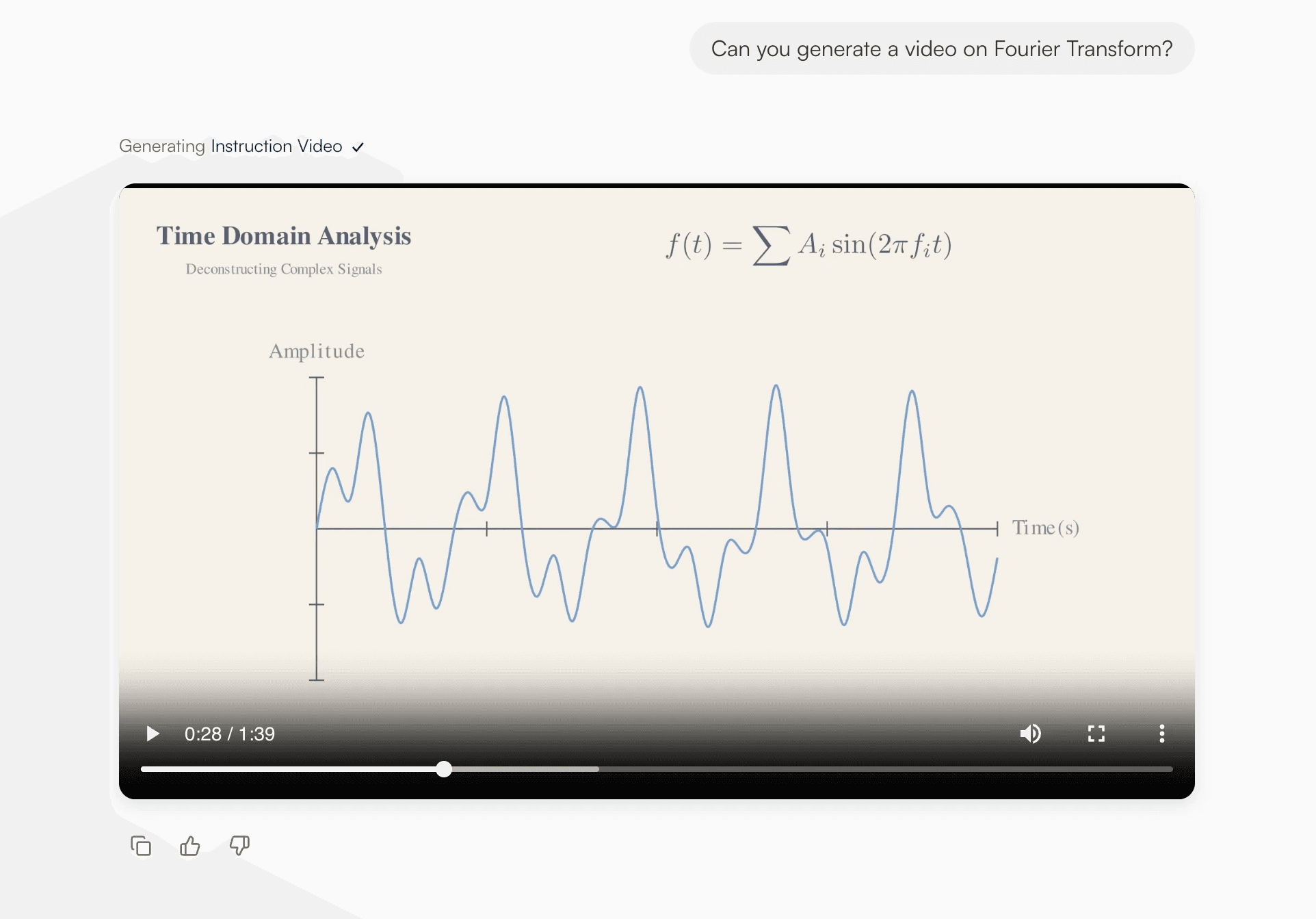
Hyperknow produces a script, narration, and visual elements. The output is a short explainer video, typically around two minutes, that walks through the concept with coordinated audio and visual presentation. The narration explains. The visuals illustrate. The two channels work together the way dual coding theory says they should.
Two minutes. Not the 45-minute lecture you are trying to avoid re-watching. Not the 12-minute YouTube video where the first four minutes are channel branding and subscriber requests. Two minutes of focused explanation on the specific thing you are trying to understand.
When This Changes the Study Session
The obvious use case is the concept that will not click through reading alone. You have been staring at the same paragraph for fifteen minutes. Understanding is not arriving. Generating a video takes less time than re-reading the paragraph a fourth time and has a meaningfully higher probability of producing comprehension.
But the less obvious use cases might matter more.
Pre-lecture preparation. You have a lecture tomorrow on quantum tunneling. You have never encountered this concept before. Generating a two-minute overview the night before gives you a conceptual scaffold that makes the lecture itself dramatically more comprehensible. You walk in knowing roughly what quantum tunneling is rather than encountering it cold. The professor's explanation layers on top of existing understanding rather than building from nothing.
Study group contributions. Your group is meeting to review for the midterm. Everyone struggled with a different concept. Generate a video for the concept you understand best and share it with the group. In ten minutes, your group has produced five short explainers covering the five topics that caused the most confusion. Everyone benefits from everyone else's work.
Rapid topic evaluation. You encounter a reference to "game theory in evolutionary biology" in a reading and want to know whether it is worth exploring further. Generate a two-minute video. Watch it. Decide in three minutes whether this topic deserves more attention or was a tangent. The alternative is opening a Wikipedia rabbit hole that consumes 45 minutes before you determine the same thing.
Complex mechanism visualization. Biochemical pathways. Circuit diagrams. Fluid dynamics. Anatomical processes. Any concept that involves sequential steps, spatial relationships, or system interactions benefits from visual representation. Text describes these systems linearly. Video can show them operating simultaneously.
What This Is Not
Calibrating expectations matters because overpromising would undermine the genuine value.
These are not Kurzgesagt productions. They are not cinematic. The visual quality is functional, not artistic. Think Khan Academy in two minutes rather than a documentary. The value is speed and specificity, not production polish.
They are not a substitute for deep engagement with difficult material. Watching a video about SN2 reactions and understanding SN2 reactions well enough to solve novel problems are separated by hours of practice. The video provides the initial comprehension. The practice provides the mastery. Confusing the two leads to the same false confidence that reading summaries produces.
They are not always better than text. Some concepts are genuinely straightforward to understand through reading. If the textbook explanation makes sense on the first pass, generating a video is wasted time. The tool is most valuable at the exact moment when text has failed and you need a different cognitive pathway to the same destination.
The Underlying Bet
Hyperknow's video generation feature is a bet on a specific claim about learning. That the bottleneck for most students is not access to information but access to the right representation of information at the right moment.
The information is already available. Textbooks contain it. Lectures covered it. The internet has it seventeen times over. What students lack is the specific representation that makes a specific concept click for their specific brain at the specific moment they need it.
A two-minute custom video generated on demand is one answer to that problem. Not the only answer. Not always the best answer. But available instantly, tailored precisely, and grounded in the actual material you are studying rather than in whatever a stranger decided to publish on YouTube three years ago.
The concept that has been bothering you all semester. The mechanism you keep getting wrong on practice tests. The theory that makes sense in lecture but dissolves the moment you try to explain it.
Type it in. Watch it make sense.
Pick the concept that has been bothering you all semester. Type it in. Watch it make sense. Try Hyperknow free.