AI Cheatsheet Generator: Turn Your Entire Textbook Into an Exam-Ready Review
Turn hundreds of pages of course materials into a focused, exam-ready cheatsheet that helps you review what actually matters.
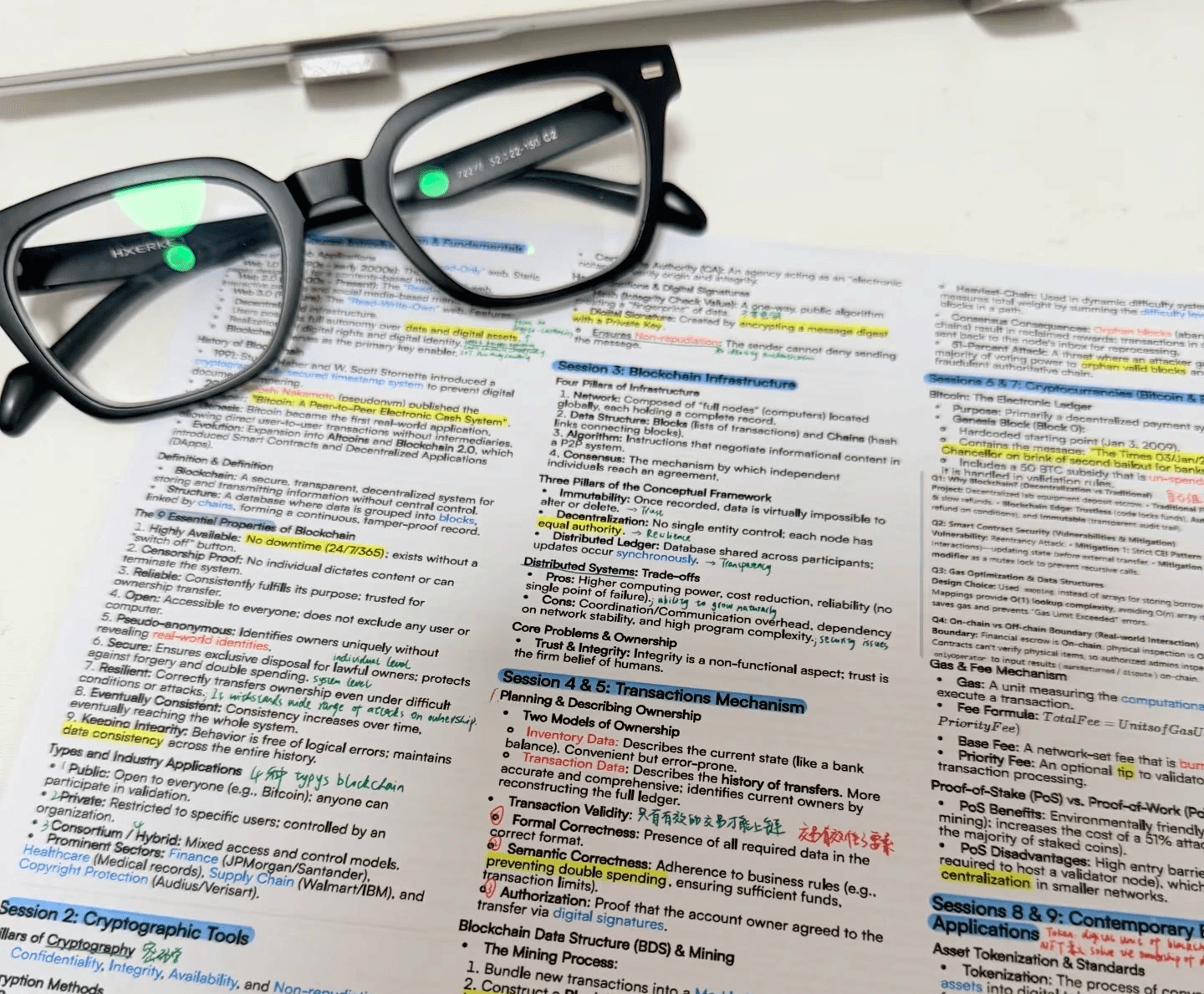
An AI cheatsheet generator is a tool that reads your course materials and produces a condensed, exam-ready study sheet covering the most important concepts, definitions, formulas, and relationships drawn from the source. Hyperknow's AI agent Orbie does this for documents as long as 1,000 pages and finishes most cheat sheets in about two minutes, with the layout fully adjustable and every concept cited back to its exact page in your upload.
This page explains how to make a cheatsheet with the tool, what the finished cheat sheet includes, why students rely on AI rather than building their study guides by hand, and how to use it across different subjects from organic chemistry to law school.
Table of Contents
Quick Answers
How to Use It
What You Get
Manual vs AI Cheatsheet (Comparison)
Why Students Use This Instead of Making Their Own
When to Use It
Subject-Specific Use Cases
What This Does Not Do
Frequently Asked Questions
Quick Answers
What is an AI cheatsheet generator? An AI cheatsheet generator reads your uploaded textbook chapters, lecture slides, or notes and produces a condensed, exam-ready study sheet that covers the most important concepts, definitions, formulas, and relationships from the source. The output is a study guide built from your specific course content rather than a generic summary pulled from the internet.
How do you make a cheat sheet with AI? Upload your course materials in any common format, type a plain-language request such as "make me a cheatsheet from these files," and the tool generates a structured, print-ready cheat sheet in roughly two minutes. With Hyperknow, the layout can be customized afterward by changing columns, font size, and highlight settings.
How long does it take to generate a cheatsheet? Most cheat sheets finish in about two minutes, with longer documents of five hundred pages or more typically completing in under three minutes. Processing time scales with the length of the uploaded material rather than with the complexity of the subject.
Can AI make a cheatsheet from a PDF? Yes, and PDFs are the most common upload format alongside PowerPoint files, Word documents, and lecture recordings. The system reads the entire document, identifies the high-value concepts, and produces a condensed output that links every point back to the originating page.
Is using an AI cheatsheet generator considered cheating? No, because using AI to help you study is still studying. The tool processes your own course materials, generates a review document from them, and presents it back for you to learn from, while the actual understanding still has to live in your head by the time you sit down for the exam.
How to Use It
Step 1. Upload your materials.
Drag in your textbook chapters, lecture slides, and class notes in any combination, since Hyperknow accepts PDFs, PowerPoint files, Word documents, and most other common formats. You can upload a single thirty-page chapter or an entire eight-hundred-page textbook in one go, which makes the tool useful for both quick unit reviews and full-semester compressions.
Step 2. Tell Hyperknow What you need.
Type a plain-language request such as "make me a cheatsheet based on these files" or "create an exam review for chapters 5 through 8," and Orbie will interpret it without you having to navigate any menus or configure any settings beforehand. You can also specify the format you want, the level of detail, or the particular topics to emphasize.
Step 3. Wait about two minutes.
Orbie reads everything you uploaded, identifies the concepts that matter most, and assembles your cheat sheet, with processing time scaling according to document length so that even uploads of five hundred pages or more generally finish in under three minutes.
Step 4. Customize and study.
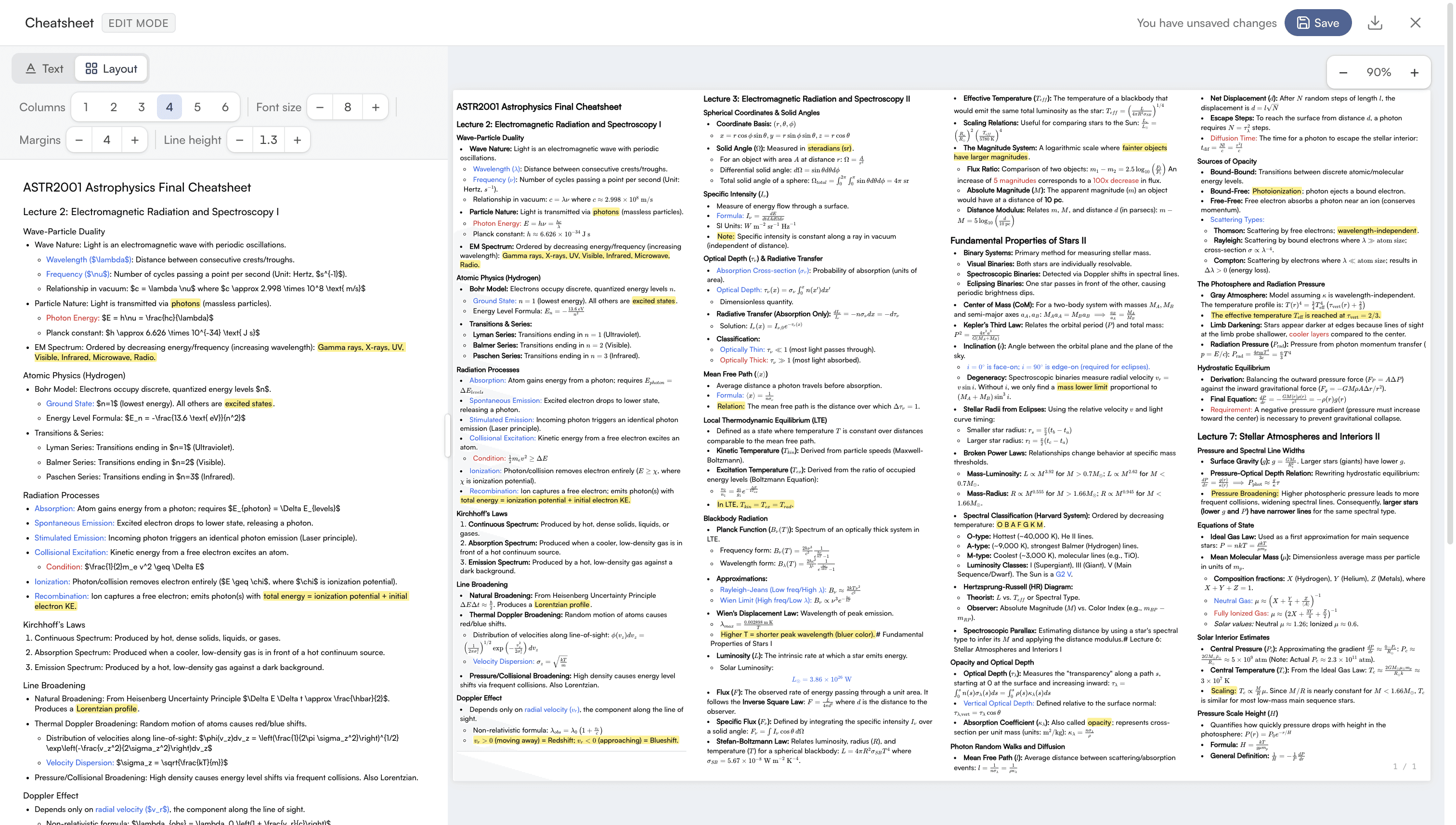
Your cheatsheet appears as a structured document with the key points already highlighted, and from there you can adjust the layout to match the way you prefer to study by changing the number of columns, increasing or decreasing the font size, toggling the highlights on or off, and rearranging the sections. You can also ask Orbie for more detail on a particular topic or generate practice questions drawn from the same uploaded material without starting over.
What You Get
The finished cheat sheet is exam-ready and print-ready the moment it generates, with the most important concepts highlighted automatically so they stand out visually as you review.
Exam-Ready and Print-Ready Format
The cheat sheet leaves the generator in a state you can use immediately, whether on screen during a digital review session or printed for an open-note exam. There is no additional cleanup, reformatting, or restructuring required between generation and study, which matters most during the compressed hours before a test.
Fully Adjustable Layout
Because the layout is adjustable across column count, font size, and highlight colors, you can format the same cheatsheet for comfortable reading on a screen, for printing, or for fitting onto a single allowed page during an open-note exam. The cheat sheet adapts to the way you want to review it rather than locking you into a single visual format.
Source Citations on Every Concept
Every concept on the cheat sheet is cited back to its exact location in your uploaded materials, which means you can trace any point to the specific page it came from whenever you want to read the fuller explanation. This citation layer also serves as a trust check, since you can always verify that the tool has not invented or distorted a claim.
Topic-Based Organization Across Chapters
The cheat sheet is organized by topic rather than by chapter, which matters a great deal because exams tend to test material thematically across the whole course rather than in the sequence the textbook happened to present it. A biology final spanning fourteen chapters, for example, would produce a cheat sheet organized around body systems such as cardiovascular, respiratory, and renal, with cross-references showing where the systems interact.
Why Students Use This Instead of Making Their Own
Building a genuinely useful study guide requires a skill that most students have not yet developed, because you need to already understand the material well enough to judge what belongs in the guide and what can safely be left out. The students who most need a cheat sheet during a difficult course are often the same students who are least equipped to build a good one from scratch, and three specific problems explain why this happens so consistently.
The first problem is that students naturally gravitate toward the material they already understand, because reviewing familiar content feels productive and reassuring. A chapter that made sense during lecture gets thorough, careful notes, while a chapter that caused confusion gets vague notes that often amount to little more than a reminder to review it later, and the result is a study guide that covers the topics you were already going to answer correctly while neglecting the topics that will actually determine your grade.
The second problem is one of compression, since students tend to either include far too much material by essentially recopying the textbook in a smaller font or far too little by selecting only the concepts they find easy and skipping the dense ones. Compressing a large body of material effectively requires having processed all of it first, and that processing is the very bottleneck that makes studying difficult in the first place.
The third problem is simply the time it takes, because building a comprehensive study guide by hand from four hundred pages of material can easily consume four to six hours that most students do not have during finals week. Many students start the effort, run out of time partway through, and end up with an incomplete guide that covers only the first few chapters of the course.
Orbie avoids all three of these problems because it reads every page of your upload with the same level of attention and processes the entire document before making any decision about what to prioritize, which means the finished cheat sheet reflects the genuine distribution of important concepts across all of your material rather than the uneven distribution of whatever you happened to remember best. Research on the testing effect and on retrieval practice has consistently shown that students learn more from focused review of well-chosen material than from re-reading entire textbooks, which is the underlying reason a good cheatsheet improves performance even when the underlying study time is reduced.
When to Use It
The most obvious time to use the cheatsheet generator is during finals week, when you need to compress an entire semester of material into a single reviewable document in the limited hours before the exam.
A more effective approach, however, is to generate a cheat sheet at the end of each unit throughout the semester, roughly every three to four weeks, so that you can review it once and flag anything that does not make sense while you still have time to attend office hours and ask questions. Students who do this arrive at finals week with a complete library of cheatsheets they have already reviewed at least once, which turns the final study period into a second or third pass through familiar material rather than a frantic first encounter with content they neglected all term.
It is also worth generating a cheatsheet before starting a new unit that builds on earlier material, because reviewing a quick summary of the prerequisite concepts means you walk into the new content with a solid foundation rather than a shaky one.
For courses that allow a single-page cheat sheet during the exam itself, the generated output works well as a starting point that you then rebuild in your own format and at your own density, since the act of selecting and reorganizing the material forces a deliberate cognitive pass through it that passive reading never achieves.
Subject-Specific Use cases
Cheatsheets for Organic Chemistry
Organic chemistry rewards pattern recognition across roughly seventy to one hundred named reactions, and a cheat sheet that maps how those reactions connect saves hours of manual diagram drawing. Uploading your textbook chapters produces a topic-based cheatsheet organized around functional groups and mechanism types with cross-references showing where reactions feed into one another, which is exactly the structure exams test. See also: How to Study for Organic Chemistry.
Cheatsheets for Medical School and MCAT
Medical school materials routinely run into the hundreds of pages per block, and the 1,000-page upload limit is built for exactly this kind of volume. Generating a cheat sheet from a full pathology chapter or a behavioral sciences section produces a condensed review that complements an Anki workflow without replacing it. See also: How to Study for the MCAT.
Cheatsheets for Law School
Casebooks and statutory materials produce dense source documents that are difficult to compress by hand. An AI-generated cheat sheet pulls the key holdings, doctrines, and statutory tests into a structured format while preserving citations back to the source pages, which matters in a discipline that relies on accurate attribution.
Cheatsheets for AP and SAT Prep
For standardized test preparation, you can upload your prep book chapters and generate cheat sheets scoped to specific exam sections, then customize the layout to fit the format that works best for your review style. See also: Best AI Study Tools 2026.
Cheatsheets Across Multiple Finals
When you have three or four finals in a single week, the time savings compound. Generating cheat sheets for each subject in sequence produces a complete review library in a single afternoon rather than the four to six hours per subject that manual compression would require. See also: How to Study for Finals When You Are Already Behind.
What This Does Not Do
The cheat sheet cannot account for the specific habits and preferences of your individual professor. It does not know that your professor reliably includes one exam question based on a story she told in lecture that never appeared in the slides, that your teaching assistant emphasized a particular type of problem during the review session, or that last year's version of the exam leaned heavily on the final three chapters of the course.
These are insights you gain by paying close attention to the people teaching your course, and they remain your responsibility. Orbie handles the work of processing hundreds of pages and organizing them into a usable review document, while you supply the judgment about which parts of that material your professor is most likely to test.
Frequently Asked Questions
How long are the cheatsheets?
The length depends on how much material you upload and the level of detail you request, so a single chapter typically produces two to three pages while a full semester of material might produce ten to fifteen pages of concentrated review. Every output is print-ready, which means you can take it straight to paper for an open-note exam.
Can I customize the output?
Yes, because the layout is fully adjustable across column count, font size, and highlight settings to match the way you study, and you can additionally ask Orbie for more detail on a particular section, request a simpler explanation of a difficult concept, or have the cheatsheet reorganized around different themes whenever you need it. The cheatsheet remains a document you can keep refining rather than a fixed file you are stuck with.
Does it work for both STEM and humanities courses?
Yes, because the system handles formula-heavy technical content from subjects like chemistry, physics, and engineering just as capably as it handles the argumentative and conceptual material found in history, political science, and philosophy, and the format of the output adapts to whichever type of content you upload.
What happens if my professor's slides contradict the textbook?
Upload both sources, and the cheatsheet will reflect the content of each while letting you ask Orbie to highlight the points where they differ, which turns out to be one of the most valuable ways to use the tool because those contradictions often point directly to the nuances an exam is most likely to test.
Is this cheating?
No, because using AI to help you study is still studying. You are processing your own course materials, generating a review document from them, and using that document to prepare, and the understanding still has to live in your own head by the time you sit down for the exam.
Upload your course materials and get an exam-ready cheatsheet in minutes. Try Hyperknow free.